“Nigerian Army Denies Shooting Women Protesters…But Their Own Report Tells a Contradictory Tale!”


By Passman Akpos
Adamawa – The Nigerian Army’s 23 Brigade has sparked outrage and confusion after issuing a statement vehemently denying claims that its troops shot women during a communal clash in Lamurde LGA, Adamawa State—only to seemingly admit the opposite in the very same document.
According to the Brigade, reports by Sahara Reporters and other online media alleging that women protesters were shot by the Brigade Commander’s escort are “baseless” and “entirely misleading.” The statement insists the Commander himself was not at the scene, participating virtually in a weekly operational briefing.
Yet, the narrative quickly takes a bewildering turn. The Brigade admits that combined forces of the Army, Police, NSCDC, and DSS intervened in clashes between the Bachama and Chobo communities, neutralizing eight armed militia members. During the operation, “some women blocked the road to deny troops passage to the Secretariat,” prompting soldiers to “create a passage” through the crowd. The statement adds, almost cryptically: “At this point, no woman was shot or injured. Otherwise, troops would not have been allowed to find any passage through the crowd.”
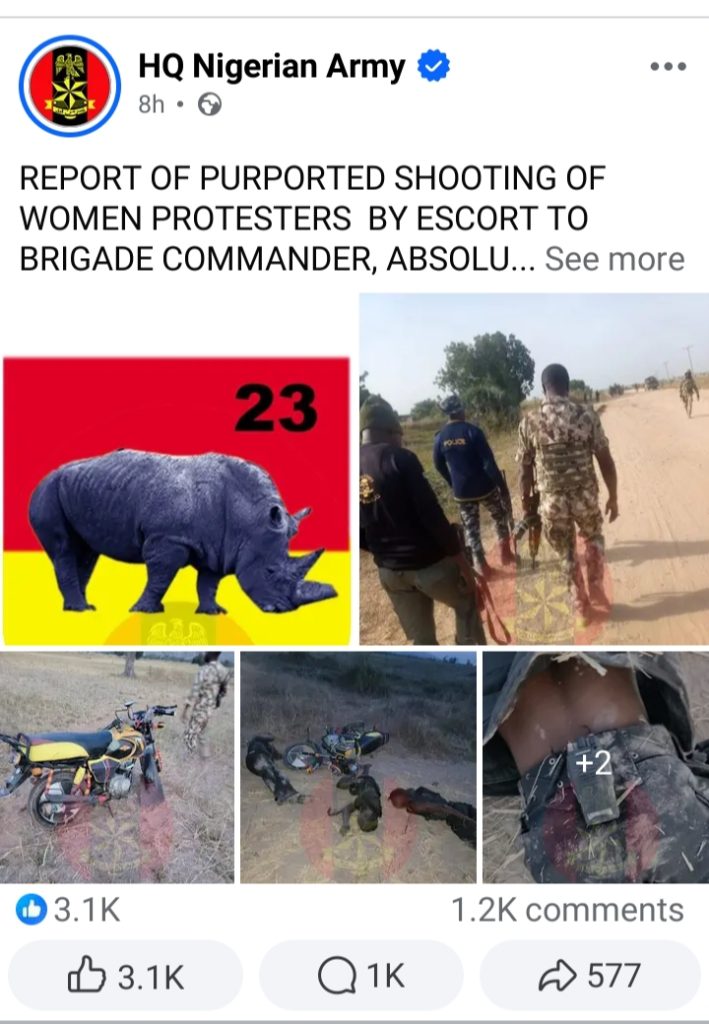
The confusing phrasing has sparked a storm of criticism online, with Nigerians questioning how a passage could have been “created” in a crowd predominantly made up of women—the same women the Army insists were not harmed. Critics highlight the glaring contradictions, noting that while the Army denies targeting civilians, its description of “clearing a passage” strongly implies some level of force was used.
Social media has erupted with incredulity and satire. One commentator wrote, “When people make denials, know it actually happened! How did the troops ‘create a passage’ anyway? Did someone politely ask the women to move aside?” Another noted, “Paragraph eight alone exposes the inconsistency: if they truly didn’t shoot anyone, why the need to create a passage?”
Despite these contradictions, the Brigade expressed “deep sympathy with the family of the slain women” and called for peace between the warring communities. Yet the episode underscores growing public skepticism about official accounts of military actions, with many questioning the transparency and professionalism of security forces in volatile areas.
The 23 Brigade insists that the report should be disregarded as “malicious,” but Nigerians appear far from convinced. For now, the only certainty is confusion, contradiction, and a clamoring for answers: exactly how was this “passage” created through a crowd of women, and who truly bears responsibility for the tragic casualties?