“Before IPOB, Before Biafra — Did You Know Nnamdi Kanu Was Once an APGA Politician?”

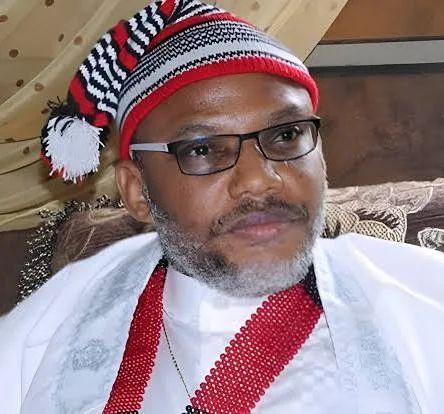
Long before his name became synonymous with separatist agitation and fiery broadcasts, Nnamdi Kanu once operated firmly within Nigeria’s conventional political space. Archived records show that in 2011, Kanu was not only a politician but a key figure in the All Progressives Grand Alliance (APGA)—serving as Chairman of APGA in the United Kingdom.
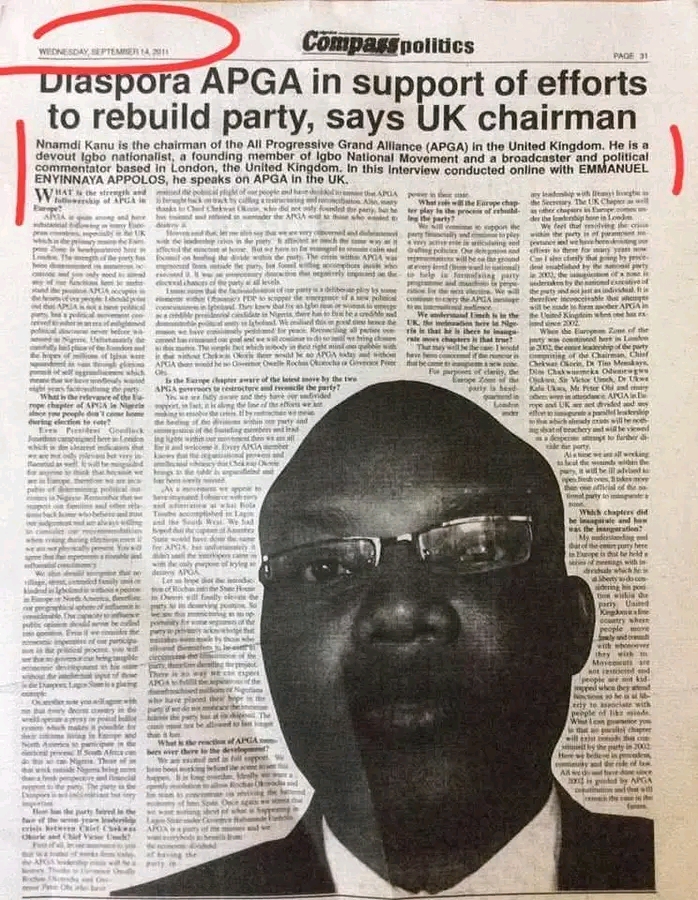
A Compass Politics publication dated Wednesday, September 14, 2011 (Page 31) provides a revealing snapshot of that chapter of his life. In the interview, conducted online with journalist Emmanuel Enyinnaya Appolos, Kanu described himself as an Igbo nationalist, a founding member of the Igbo National Movement, and a London-based broadcaster and political commentator—all while actively working to strengthen APGA’s diaspora structure.
Building APGA from the Diaspora
As UK chairman, Kanu spoke passionately about mobilising Igbo people in the diaspora, rebuilding party unity, and supporting APGA’s electoral prospects back home. He emphasised the importance of resolving internal crises within the party, fostering unity among members, and positioning APGA as the political home for Igbo aspirations.
At the time, APGA was widely seen as the party that best represented South-East interests, particularly following its association with the late Dim Chukwuemeka Odumegwu Ojukwu. Kanu’s role placed him squarely in the effort to translate ethnic identity into political power through democratic means.
From Party Politics to Radical Activism
Fast forward to today, and the contrast is stark.
Kanu is no longer a party organiser or diaspora chairman. Instead, he emerged years later as the leader of the Indigenous People of Biafra (IPOB), rejecting Nigeria’s political structure entirely and advocating outright secession. His shift from ballots to broadcasts, from party meetings to mass agitation, raises a lingering question many Nigerians continue to ask:
What happened?#Political analysts point to a mix of factors:
Disillusionment with internal party politics
Repeated crises within APGA and the wider Nigerian political system,
And a growing belief that Igbo interests could not be secured through elections alone.
Others argue that Kanu’s media background and nationalist ideology found a more receptive audience in activism than in party bureaucracy, especially among frustrated youths.
A Forgotten Chapter, A Critical Context
The 2011 interview is significant because it challenges the simplified narrative that Kanu has always stood outside Nigeria’s political framework. He once tried the system—from within a recognised political party—before turning his back on it.
Whether seen as evolution, radicalisation, or abandonment of democratic engagement, Nnamdi Kanu’s APGA past remains a crucial, often-overlooked chapter in understanding his journey and the broader Igbo political question.
From APGA chairman in London to one of the most controversial figures in Nigeria’s modern history, Kanu’s story is not just about separatism—it is also about a political path that began inside the system, and the moment it broke apart.