Lavish Life, Public Money? Dangote Alleges NMDPRA Boss Spends Millions Abroad as Citizens Struggle!

By Passman Akpos
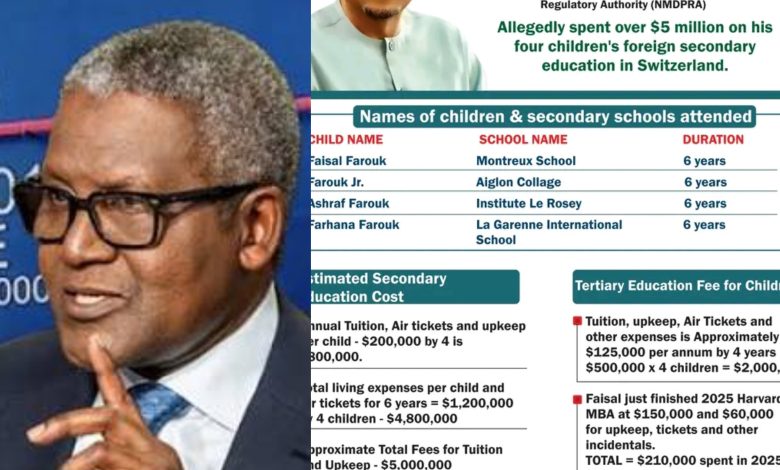
Africa’s richest man and chairman of the Dangote Group, Aliko Dangote, has alleged that Farouk Ahmed, chief executive officer of the Nigerian Midstream and Downstream Petroleum Regulatory Authority (NMDPRA), spent about $5 million on the secondary school education of his children in Switzerland.
In a paid newspaper advert published on Tuesday, Dangote detailed claims that Ahmed allegedly funded the foreign education of four of his children over a six-year period, describing the expenditure as an act of “economic sabotage and corruption.” The allegation follows Dangote’s earlier statement on Monday in which he accused the NMDPRA boss of paying millions of dollars to Swiss schools while serving as a public officer.
According to the advert, the children named are Faisal Farouk, Farouk Jr., Ashraf Farouk, and Farhana Farouk. Dangote listed the schools allegedly attended as Montreux School, Aiglon College, Institut Le Rosey, and La Garenne International School, all in Switzerland. He estimated the annual cost per child—covering tuition, air tickets, and upkeep—at $200,000, amounting to $800,000 per year for four children. Over six years, total expenses were placed at approximately $4.8 million, which Dangote rounded up to $5 million.
The advert further alleged additional spending on tertiary education, claiming that one of the children, Faisal Farouk, completed an MBA at Harvard University in 2025, with tuition and related expenses amounting to about $210,000 for that year alone.
“Facts don’t lie,” Dangote declared in the advert, questioning the source of such funds. He argued that Nigerians deserve transparency, particularly as many families in Ahmed’s home state of Sokoto reportedly struggle to pay basic school fees of ₦10,000.
As of the time of filing this report, Farouk Ahmed and the NMDPRA have not publicly responded to the allegations. No official investigation has been announced, and the claims remain unproven.
The accusations have nonetheless ignited intense public debate, renewing calls for greater accountability, asset transparency, and scrutiny of the lifestyles of public officials amid Nigeria’s ongoing economic hardship.