“Army Rules Trashed at Aso Rock: How Tinubu’s ADC ‘Jumped the Queue’ to Brigadier-General”
..........Controversy Erupts Over Alleged Accelerated Promotion of President’s ADC, Nigerians Raise Alarm

By Passman Akpos
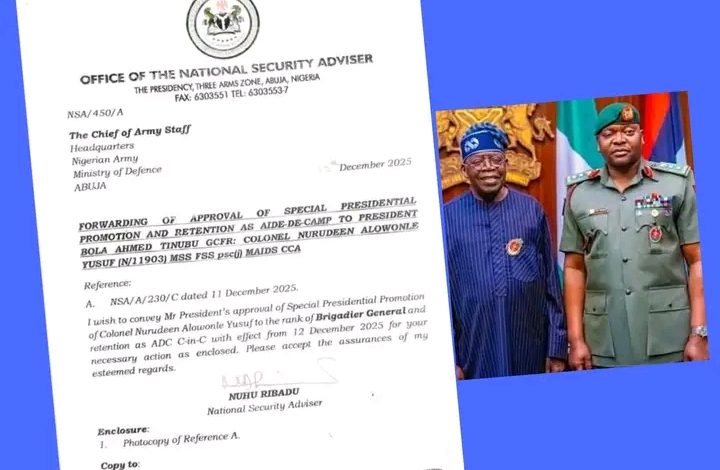
A fresh controversy has erupted within Nigeria’s security and political space following claims that President Bola Tinubu has approved the accelerated promotion and continued retention of his Aide-de-Camp (ADC), Col. N.A. Yusuf, through a communication reportedly conveyed by the National Security Adviser (NSA).
According to the claims, Col. Yusuf was decorated as a Colonel in January this year, making his reported elevation to Brigadier-General his second promotion within a twelve-month period—an action critics say sharply contradicts established military tradition and the Armed Forces Terms and Conditions of Service.
In the Nigerian Army, officers are ordinarily required to spend a minimum of five years at the rank of Colonel and attend either the Armed Forces Command and Staff College (War College), the National Defence College (NDC), or an equivalent institution before being considered for promotion to Brigadier-General. Critics argue that Col. Yusuf has not met these professional requirements.
Observers further note that as a 52 Regular Course officer, the alleged promotion places him senior to officers of earlier courses—some of whom have completed all mandatory professional training and are legitimately awaiting promotion.
“This is unprecedented,” the statement argues, noting that from 1960 to date, no President’s ADC has enjoyed such an exception. It cites the example of the late President Muhammadu Buhari’s first ADC, then Col. M.L. Abubakar (now a Brigadier-General), who reportedly had to disengage from ADC duties to attend the National Defence College and remained a Colonel for five years before promotion.
Even more controversial, critics say, is the reported retention of Col. Yusuf as ADC after his elevation—an arrangement described as “alien to military culture,” where ADC roles are traditionally held by junior officers, not generals.
Broader Pattern Alleged
The controversy has widened beyond the military, with allegations that similar accelerated promotions have occurred within the Nigeria Police Force. Particular attention has been drawn to the Chief Personal Security Officer (CPSO) to the President, CP Usman Shugaba, who is alleged to have received multiple rapid promotions, leapfrogging senior colleagues primarily due to proximity to power.
“This practice may be familiar within the Police system,” the statement contends, “but it is alien to the military, where hierarchy, seniority, and professionalism are sacrosanct.”
Critics have also questioned the role of the NSA—himself a retired police officer—suggesting that what they describe as “police-style disorder” is being imported into military institutions.
Nigerians React
The claims have triggered heated reactions across social and political circles, with many Nigerians expressing concern over the long-term implications for discipline, morale, and institutional integrity.
Some commentators argue that favoritism in promotions is not new in Nigeria, citing historical precedents. Others warn, however, that normalizing such practices risks deepening demoralization within the ranks and forcing highly trained senior officers into premature retirement.
One reaction reads:
> “If such highly favored officers later become service chiefs, many senior officers will be forced out after less than 30 years of service, despite the huge resources spent training them. They are creating future problems for the military.”
Another warned ominously:
> “When privilege overtakes process and proximity replaces professionalism, institutions begin to rot quietly—from the top.”
There were also more caustic reactions accusing the administration of entrenching favoritism, with some warning that persistent violations of military norms could destabilize civil-military relations.
A Question of Leadership and Standards
While emphasizing that the issue is “not about Col. Yusuf as an individual,” critics insist the ultimate responsibility lies with the President, who authorizes exceptions and sets the tone for governance.
“This is about the message being sent to officers who played by the rules,” the statement concludes. “A system that rewards access over merit cannot command discipline, loyalty, or trust. This is how institutions collapse—incrementally and quietly.”
As of the time of filing this report, neither the Presidency, the Nigerian Army, nor the Office of the National Security Adviser has issued an official response to the allegations.
The debate, however, continues to intensify, with many Nigerians insisting that something must give to preserve professionalism, morale, and the integrity of the country’s security institutions.